In this essay I will be writing about my chosen subject area which is Makeup and special effects the time period I will be looking into is the 1950's for T.V and film. Makeup and special effects within films in the 50's wasn't as good as it is today. I will be talking about how it was done in the 50's and how it has changed over the years. Alongside general makeup on a day to day basis.
1950's special effects
In the 1950s televisions took over, this meant no more paying to see films as it was available to view for free in their own houses. Moving up in the world they started to film most movies using colour alongside this they also worked to improve the size and quality of the image and widescreen was finally introduced. Whilst people were to watch films for free in their own homes and now in colour theatres were closing as the mass of people watching films at home increased and the population decreased watching at theatres. Movies at this time tended to be violent and action moving at a lot faster pace. As the vast majority of theatres were closing down the special effects department were also closing as they had such little use. For years people struggled to create special effects as it wasn't as simple as it may seem and they needed new ways in which they could make it more advance, But the public were unaware of how hard and complicated it was to bring a still image to life and as of this they admired film artists because they were able to do so.
How has it changed over the years? well like where as in the 50's people were struggling to create special effects and it was like magic now people just upload a computer and its all done on programmes also it is better, faster and cheaper than the 50's. Both in the 50s and as of today creating special effects takes a lot of work to create. In the 1950s, Bruce Mozert explored and did what no one had every done he sealed his camera in a waterproof case and it was an astonishing outcome and this is where underwater technology started. Television changed America that wouldn't come again until the internet, before internet, Television was most effective way to get things out there because everyone was watching the same thing due to there only being one channel BBC. Over the years the stations grew also advertisements. When television grew the genres of shows grew too.
social environment.
At this time in the 50's colour was a big thing and it was used for TVs this helped show colours of the picture and was much better than an original black and grey colour was a big improvement on the earliest television technology in which the image is displayed in shades of grey. In the 1940s' war in Britain was still ongoing, throughout the war trade routes were cut off. What happened in the British war was rationing, everyone had to try and make food last as trade routes were cut off this effected everyone Because of rationing it wasn't just food so design slowed down a little rationing finally stopped in the 1954.. In 1952 seven years after war had finished every one went mad after being starved of things so they craved for colour and other things. In the 40's Britain had lots of bombings where lots of houses were lost and cultures were attatcked by cathedrals being bombed. Houses in the 50's were flat terraced houses with toilets outside not like our houses today with toilets maybe two one downstairs as well as upstairs. At this point both men and women could work not just men as it was wrong for women to work as they were seen as to be housewives. As things advanced after the war electricity was becoming more popular inside the houses along side washing machines and this was due to both men and women working so it was affordable. This influenced special effects as people had enough money to buy televisions that now had colour and special effects was becoming more effective. As everyone had a craze after the rationing TVs were a big part of the craze sales rose and 4.4 million families in America had a television sets where there free time was sat watching TV. People spent so much time watching TV, that movie attendance dropped and so did the number of people listening to radios. Abstract expressionism and artists were influential but colour field paintings became more popular. The style of clothing and housing furniture and many other things became brighter and more positive, there was nothing bad, this is where pop art the art movement emerged. it started in England and made its way to the united states in the 1960's. when appeared in Britain it referred to mass media and comics. Andy Warhol was a big pop artist he released a lot of work like photography, installations and one that caught my eye a series of experimental films called 'Empire' it was an eight hour shot of the empire state building.
Festival of Britain:- (1951) Herbert Morrison, was one of the main organisers as he was the labour MP. The festival was an exhibition where everyone celebrated the recovery after the Second World War. Although it was a national festival, London was at its heart as after the war London was still in ruins. Many Londoners saw their first ever television pictures. More than half sponsored documentary films were made for the Festival. The festival was to have shown the future by being alive and colourful. It was a celebration to show a battered country can make a new future with science, design and innovation. Was good to get people together and be happy. It was a new vision of what Britain could look like, they were building a future and a new begging. It was to have changes Britain forever.
films in the 50's
A film that really indulged me in the 50's was 'The creature from the black lagoon' (1954). This film is about scientist that capture the gill man from the black lagoon, he breaks free and he returns to the black lagoon to kidnap Kay Lawrence with who he has fallen in love with. In the 1950s, Bruce Mozert explored and did what no one had every done he sealed his camera in a waterproof case and it was an astonishing outcome he did this to record Ginger Stanley underwater for the scenes of this film. Ginger Stanley is known as Kay Lawrence her name in this film, the beauty that the Gillman falls in love with the moment he spies her swimming above him. The actor playing the creature was Ben Chapman (on land). Robert Hickman was one of the main makeup artists on creating the gill man he is also known for the makeup in the film Around The World In Eighty Days (1956). The costume was made from foam rubber which shows it was made simply and not with the high technologies we have today. The costume wasn't very heavy but it took 2-3 hours to get in and out of. It has been 48 years since the film so costume has now disintegrated as it was only made from foam rubber. The three costume designers were three brothers Bud Westmore, Jack Kevan & Chris Mueller called the 'Westmore family'. Bud Westmore and Jack Kevan were the two who transformed ben into the creature.
Whilst looking into the Westmore family I got really indulged into their work for the film Mr. Peabody and the mermaid (1948) and This island Earth (1995).
This island earth is a horror/sci-fi film about aliens who seek scientists to help them from earth in their war. Bud Westmore was the makeup artist within this film working along side
Cleo E. Baker working on special effects. Unlike most other 1950s the Gill Man (Creature from the Black Lagoon ), the Metaluna mutant for This Island Earth (1954),Special effects films, which were Monster Movies, This Island Earth becomes a Space Opera halfway through. The "mutant" costume originally had legs in comparison to the upper body but they struggled making the legs look and work properly they were made by studio deadline to have the mutant wear a pair of trousers but as posters were shown that the mutant was supposed to have legs. Faith Domergue was wearing the costume and said it was too tight that she was unable to wear underwear. Most of the sound effects were picked up on a short length and played at different speeds. A shot from this film is shown briefly in the film 'E.T'
Another film that I was interested in was The Beast From 20,000 Fathoms (1952). This was the first film that used a split screen technique to insert models into the live-action later known as 'Dynamation'. Ray harryhausen was offered to take this film on board in 1951 after he had shown Jack Dietz models and drawings, alongside little sections on Evolution and Mighty Joe Young. There must have been a spark as they also gave their approval for the use of Rays stop-motion. As Ray was so determined to work on this project he didn't make much of a profit and lost out but he wasn't bothered as the film was big at the time.
The difference between the first two films and the last on is that the first two had artists for costumes special effects and makeup ect. But in the last film it had used dynamation for the first time ever.
Ray Harryhausen
Ray Harryhausen was a genius in the 50s well known for his work of many films which contained special effects, realistic creatures and helped develop stop motion model animation an a split screen technique called dynamation. The first film Ray did the technical effects for was in 1953 and it was a film called 'the beast from 20.000 Fathoms'. In this film it was when Ray first used a technique he created called "Dynamation" that split the background and foreground of pre-shot live action footage into two separate images.
Millicent Patrick
Millicent Patrick was a costumer, character designer, and illustrator for many films back in the 50's. She took a big role in creating the SF cinema’s most distinctive characters. she was known as Mildred Elizabeth Fulvia di Rossi. She was the daughter of an architect and engineer. Millicent's early ambitions were to become a concert painter where she didn't follow through with this she went to study art on a scholarship and later became hired by Disney as an animator in the 40's. She was the first every female to be hired by such a big studio. Millicent designed both the creatures from the above films the Gill Man (Creature from the Black Lagoon ) and the Metaluna mutant for This Island Earth (1954). She was a very big name in industries and was amazing at what she did and everyone wanted to see what she had to offer.
Bud westmore
Bud westmore was a very talented man who specialised in special effect for films in the 50's. His family are well known for makeup 'Westmore Family'. Over 450 movies and television shows he has been credited for. From the first film 'The creature from the black lagoon' he assisted the designer where he was credited for his creatures conception Not just films but Westmore also worked very hard on television. In 1957 Bud Was asked to design a makeup model of their soon to be iconic doll which he produced the Barbie doll. As everyone knows now the Barbie doll is well known and has been effective. in 1959 it was introduced with both blonde and brown hair. The largest building on the Universal Studios Backlot is named in his honour. He was a tremendous and very creative man.
I chose these three Artists as these were the ones who indulged me the most and the films that these artists are in seem to be very interesting. I find it hard to watch films now days never mind watching films from the 50's but these for some weird reason I got stuck into and I think the reason for that is because I have researched into how the costumes were made and how the special effects were created. And I like the alternate between the costume, the special effects and also the stop motion model animation. I decided to include Millicent Patrick into this as she was a female and at the time in the 50's it was just the start where females were aloud to work and she also blew me away with her work and it was very interesting. Its not very often to find women working on such things like this in the 50's.
I chose to write about my subject area (special effects and costume) in this decade as we see special effects now and everything is all high tech and simple but where as in the 50s they went through lengths to try create such magical work for the nation to be happy and joyful after the war. I really enjoyed doing this research in my contextual lesson and thought it would be good to write an essay upon.
Showing posts with label Unit 5 Contextual Studies. Show all posts
Showing posts with label Unit 5 Contextual Studies. Show all posts
Thursday, 2 July 2015

Tuesday, 24 March 2015
1960's Fluxes and Conceptual Art
Conceptual Art
more about the artists and the artists idea,no skills needed.
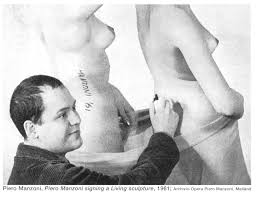
Piero Manzoni:
Artist of early 60's signature was his magic medium to make women into art work,
it was like them being used by the artists as his material, like a prisoner of his idea. He died at 29.
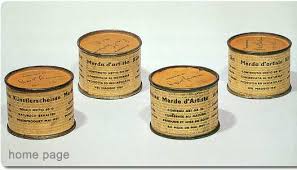
His most famous work a pile of shit,cans of his own shit in 1961, shit of a artist.
Fluxes: Everyone being tight fluxes was to liven everyone up, members from all over world. 15 or 16 years. movement so daft had such an impact.
Sarah Lucas:- rude hairy
fluxes is people doing weird stuff in 1960s but now its an art movement or something that happened in art, was a gigantic realise of energy, culture. burst of creativity. done as a joke presented as art.
Yoko ono:- cut peice 1965
sits on stage and audience comes and cuts bits of her clothing.
fluxes festival: 1962 performances silly actions, some violent, using random objects.
Joseph beuys: fluxes performance. a connection with animals and natural energy.
more about the artists and the artists idea,no skills needed.
Piero Manzoni:
Artist of early 60's signature was his magic medium to make women into art work,
it was like them being used by the artists as his material, like a prisoner of his idea. He died at 29.
His most famous work a pile of shit,cans of his own shit in 1961, shit of a artist.
Fluxes: Everyone being tight fluxes was to liven everyone up, members from all over world. 15 or 16 years. movement so daft had such an impact.
Sarah Lucas:- rude hairy
fluxes is people doing weird stuff in 1960s but now its an art movement or something that happened in art, was a gigantic realise of energy, culture. burst of creativity. done as a joke presented as art.
Yoko ono:- cut peice 1965
sits on stage and audience comes and cuts bits of her clothing.
fluxes festival: 1962 performances silly actions, some violent, using random objects.
Joseph beuys: fluxes performance. a connection with animals and natural energy.
Tuesday, 17 March 2015
The 1960's
The 1960's
British Pop Art started around the same time as pop art in America.
collage came back in 1960's
just what is it that makes today's home so different, so appealing?

Richard Hamilton- 1956 exhibition- This is tomorrow in London.
The late 50's hamilton produced this work and in the 90's was asked to remake this art work for the 90's. In the image the lollypop says pop on it many people think this is where the name pop art comes from or thats where it gets its name.
food on the table, wife home, entertainment and exciting stuff show, new modern furniture, tape recorder,comments about the cleaner, a television showing someone on telephone, mr universe and Joe Baer (glamour) ,The moon is in the top of the photo, space race who will land on the moon first.
The video pop goes to easel
peter phillips youngest from Birmingham
Pauine
Derek bosure from portsmouth 24- finishing royal college
Peter Blake
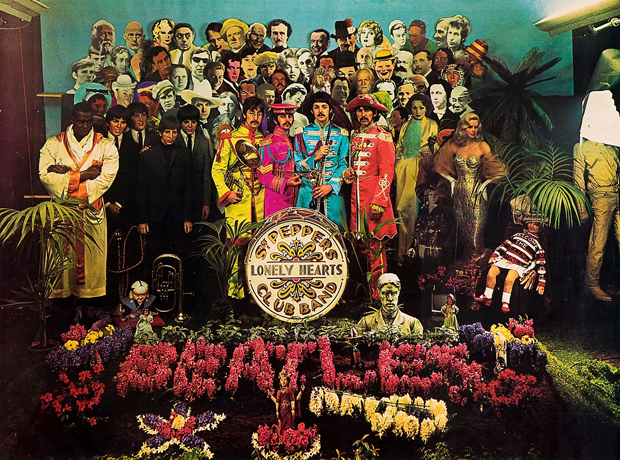
Sgt Pepper this is one of Blakes collages created with Jann Haworth released in 1967. This collage holds 88 people including celebrities.
Alan Jones- Britsh
chair, hat stand, table

plastic new and funky and looks appealing but the subject matter is very sexist.
women designed as household objects
Just had exhibition at royal academy.
Video of allen jones with dvid hockney in it dancing
american pop
lichtenstein pop comic book
do some research
Op Art
Bridget Riley do some research
All hand painted and she influenced art into fashion.
Bridget riley and Mary Quant.

1960s fashion
Before pop but coming out of abstract expressionism and pop art link, Robert Rauschenberg. bed
assemblage attactched objects to canvas
tube of pint on the canvas represents its time for paint to be put away.
Jasper Josh from abstract expressionism to american pop. layered textual using everyday images, numbers,circus, american flag.
lichtenstein pop comic book
do some research
Op Art
Bridget Riley do some research
All hand painted and she influenced art into fashion.
Bridget riley and Mary Quant.
1960s fashion
Before pop but coming out of abstract expressionism and pop art link, Robert Rauschenberg. bed
assemblage attactched objects to canvas
tube of pint on the canvas represents its time for paint to be put away.
Jasper Josh from abstract expressionism to american pop. layered textual using everyday images, numbers,circus, american flag.
Monday, 23 February 2015
1950's costume and special fx
Creature from the black lagoon- Roberts Hickman
Ben Chapman was an actor who played the title character of ‘The Creature From The Black Lagoon’ (on land)

Ben chapman had an interview and the questions asked were:
What was the costume made of? How heavy was it? How long did it take you to get in and out of the costume?
In which he replies:-
Well, the costume was made out of foam rubber, and there was a latex one piece body stocking that I got into.
It was very simply made, its not like the high tech stuff of today
The costume wasn’t very heavy because it was made out of foam rubber, and it took about 2-3 hours to get in and out of.
It fit my body like an outer layer of skin so as we went along it was easier to get in and out of.
What type of breathing device was provided in the costume for the water scenes?
(Chapman appeared as the creature in all above water scenes.)
Ricou Browning played the gill man under water.
Ben said Ricou Browning didn’t use anything when he doubled me underwater.
Ricou Browning was a champion swimmer, we could go down to 60-70 feet and hold our breathes for 4/4 and a half minutes,
Ricou Browning never had any kind of a breathing device.
They were thinking about it, but they couldn't get one to fit in the dorsal fin on the back of the suit. The main reason is that fish do not emit bubbles. With a breathing device, he would have emitted bubbles.

Where are the costumes now?
Below is a list of make up artist from the film 'creature and the black lagoon'
Robert Hickman (makeup artist):-
There wouldn’t be any left today, because after 48 years, foam rubber in air would just turn to powder, so if anybody were to say that they have a “original” I would be very skeptical about it. As far as I know, I’ve been doing shows for some time, and I’ve talked to a lot of experts, and they all say the costume is gone.
Robert Hickman is known for Around The World In Eighty Days (1956) and Creature from the Black Lagoon (1954) which are both from the 1950's. Robert was a makeup artist in both of these films.
Around The World In Eighty Days:
 Best costume Design,colour- Miles White
He was a top costume designer of Broadway musicals for 25 years. He is known in the entertainment industry for his imaginative and witty designs.
Bud Westmore (make up artist):-

Mr. Peabody and the Mermaid - 1948
Bud westmore also did costume for this film.
Making the mermaid
-They made a mold of Ann's body by smooshing clay or Play-Doh or Silly Putty, or whatever they had in the junk drawer, from her torso to her toes.
-Once this was done they started covering Ann in plaster
-Ann layed on a sort of operating table for three hours while being molded in clay and plaster


Ben Chapman was an actor who played the title character of ‘The Creature From The Black Lagoon’ (on land)

Ben chapman had an interview and the questions asked were:
What was the costume made of? How heavy was it? How long did it take you to get in and out of the costume?
In which he replies:-
Well, the costume was made out of foam rubber, and there was a latex one piece body stocking that I got into.
It was very simply made, its not like the high tech stuff of today
The costume wasn’t very heavy because it was made out of foam rubber, and it took about 2-3 hours to get in and out of.
It fit my body like an outer layer of skin so as we went along it was easier to get in and out of.
What type of breathing device was provided in the costume for the water scenes?
(Chapman appeared as the creature in all above water scenes.)
Ricou Browning played the gill man under water.
Ben said Ricou Browning didn’t use anything when he doubled me underwater.
Ricou Browning was a champion swimmer, we could go down to 60-70 feet and hold our breathes for 4/4 and a half minutes,
Ricou Browning never had any kind of a breathing device.
They were thinking about it, but they couldn't get one to fit in the dorsal fin on the back of the suit. The main reason is that fish do not emit bubbles. With a breathing device, he would have emitted bubbles.

Where are the costumes now?
Below is a list of make up artist from the film 'creature and the black lagoon'
Robert Hickman (makeup artist):-
There wouldn’t be any left today, because after 48 years, foam rubber in air would just turn to powder, so if anybody were to say that they have a “original” I would be very skeptical about it. As far as I know, I’ve been doing shows for some time, and I’ve talked to a lot of experts, and they all say the costume is gone.
Robert Hickman is known for Around The World In Eighty Days (1956) and Creature from the Black Lagoon (1954) which are both from the 1950's. Robert was a makeup artist in both of these films.
Around The World In Eighty Days:

He was a top costume designer of Broadway musicals for 25 years. He is known in the entertainment industry for his imaginative and witty designs.
Here is an image of Jack Kevan and bud Westmore transforming ben into the creature from the black lagoon.

Bud was a makeup artist in Hollywood. Son of Goerge Westmore, a member of the Westmore family prominent in Hollywood make-up.or His involvement in Creature from the Black Lagoon he assisted the designer of the Gill Man, Disney animator Millicent Patrick,
Perc, Wally and Bud Westmore.(Westmore family)

Bud was a makeup artist in Hollywood. Son of Goerge Westmore, a member of the Westmore family prominent in Hollywood make-up.or His involvement in Creature from the Black Lagoon he assisted the designer of the Gill Man, Disney animator Millicent Patrick,
Perc, Wally and Bud Westmore.(Westmore family)

Mr. Peabody and the Mermaid - 1948
Bud westmore also did costume for this film.
Making the mermaid
-They made a mold of Ann's body by smooshing clay or Play-Doh or Silly Putty, or whatever they had in the junk drawer, from her torso to her toes.
-Once this was done they started covering Ann in plaster
-Ann layed on a sort of operating table for three hours while being molded in clay and plaster
-The fish tail cost $23,000 to make.It was four foot and was made of sponge and rubber.
-Each scale of the tail will be sewn a glass jewel for the sparkle effect,there were 4,000 jewels all together.
-Lead weights were placed in the bottom of the tail by her feet, 30-50 pounds this was to keep the rubber tail, and the person wearing it, from floating to the surface of the water.
The Munsters:-
research this film for Bud west more
http://horrorpedia.com/2014/08/25/bud-westmore-make-up-artist/
Jack Kevan:- He has made contributions to films in numerous categories, including Westerns and comedies, but is best known for his work in horror and science fiction movies, among them Creature from the black lagoon, The mole people, and This Island Earth.
Jack kevan was the producer of the film,The Monster of Piedras Blanca (1959)
also he did the special effects for the monster costume which looks like a nastier version of "The Creature from the Black Lagoon,"
The mole people:
This mask was made using foam latex mask sculpted by Jack Kevan under the authority of Bud Westmore at Universal. The eyes are covered with convex lenses and hand-painted with detail. The mask is brittle from the 50+ years since its creation, but remains in very good condition overall.

This Mole hand is made of foam latex measuring approx. 15 in. long. Its a wonderful relic from 1950s Universal horror.

This Island Earth
Aliens come to Earth seeking scientists to help them in their war. In this film Jack Kevan was a mutant constructor and Bud Westmore was one of the makeup artists.
Here is Bud Westmore painting the
look at this!!
http://horrorpedia.com/2014/08/25/bud-westmore-make-up-artist/
- Chris Mueller
Tuesday, 13 January 2015
Art Nouveau
the alor of art
1890s astablished
harkles reno mackintosh-Glasgow school of art
William morris
1890s astablished
harkles reno mackintosh-Glasgow school of art
William morris
The 1950's design
free world
colour
cars
1950's Russian car
1950s british design
kitchen
housing
lifes
utilities
1940s' war in Britain , throughout war trade routes were cut off,
what happened in Britain in war? rations- making food last,because trade roués were cut off
rationing finished?
because of ration it wasn't just food so design slowed down a little.
restrictions on metal and had to buy whitwear.-utility wear
ship ceramics to America decorate export wear not home wear.
1952 7 years after war finished still rasioned
after rasions every one goes mad after being starved of things so crave colour ect
Festival of Britain 1951
research into this,logo
to give the British a feeling of recovery in the aftermath of war and to promote the British contribution to science, technology, industrial design, architecture and the arts
1950's Britain.
bombs
attacked culture-cathedrals bombed
loose a lot of houses,
1950 buildings,flats tarraced houses, toilets outside.
pre-war experience
housewives
start fire first thing
cooking
then boil water
wash
cook again.
appliances in the post-war
both men and women could go to work.
electricity into the home
washing machine
afford it as both working so more money
coronation
furniture
fabrics
ceramics
plastics
colour
cars
1950's Russian car
1950s british design
kitchen
housing
lifes
utilities
1940s' war in Britain , throughout war trade routes were cut off,
what happened in Britain in war? rations- making food last,because trade roués were cut off
rationing finished?
because of ration it wasn't just food so design slowed down a little.
restrictions on metal and had to buy whitwear.-utility wear
ship ceramics to America decorate export wear not home wear.
1952 7 years after war finished still rasioned
after rasions every one goes mad after being starved of things so crave colour ect
Festival of Britain 1951
research into this,logo
to give the British a feeling of recovery in the aftermath of war and to promote the British contribution to science, technology, industrial design, architecture and the arts
1950's Britain.
bombs
attacked culture-cathedrals bombed
loose a lot of houses,
1950 buildings,flats tarraced houses, toilets outside.
pre-war experience
housewives
start fire first thing
cooking
then boil water
wash
cook again.
appliances in the post-war
both men and women could go to work.
electricity into the home
washing machine
afford it as both working so more money
coronation
furniture
fabrics
ceramics
plastics
DADA
Elsa von Freytag-Loringhoven was a German-born avant-garde, Dadaist artist and poet. He influenced dada by suggesting the urinal to Duchamp.
Marcel Duchamp - He was a French-American painter, sculptor, chess player, and writer whose work is associated with Dadaism and conceptual art,
The Fountain:- It was voted as the iconic image of the 20th century and the most influential. Fountain was rejected by the committee, even though the rules stated that all works would be accepted from artists who paid the fee. Fountain was displayed and photographed at Alfred Stieglitz's studio, and the photo published in The Blind Man, but the original has been lost.

The Fountain:- It was voted as the iconic image of the 20th century and the most influential. Fountain was rejected by the committee, even though the rules stated that all works would be accepted from artists who paid the fee. Fountain was displayed and photographed at Alfred Stieglitz's studio, and the photo published in The Blind Man, but the original has been lost.
What is DADA? Dada was an art movement of the European avant-garde in the early 20th century. begun during first world war. Many claim Dada began in Zurich, Switzerland in 1916, spreading to Berlin shortly thereafter but the height of New York Dada was the year before, in 1915 Dada was an informal international movement, with participants in Europe and North America. Artists had their aim to destroy what art was and to create their one new style.
Founder of dada was an German writer called Hugo Ball
He led the Dada movement in Zürich, and is one of the people credited with naming the movement "Dada", by allegedly choosing the word at random from a dictionary.
Dada comes from the dictionary. It is terribly simple. In French it means "hobby horse". In German it means "good-bye", "Get off my back", "Be seeing you sometime". In Romanian: "Yes, indeed, you are right, that's it. But of course, yes, definitely, right". And so forth.
In 1916 Hugo founded a nightclub called cabaret voltaire it was used for political proposes and by artists
Below is an image of Hugo performing at cabaret voltaire

Alfred Jarry influenced dada and himself was very absurd in his work. The first and most famous of Alfred Jarry's Ubu plays is Ubu Roi or Ubu Rex.
Ubu Roi:-
Ubu Roi is a play by Alfred Jarry. It was first performed in Paris at the Théâtre de l’Œuvre, causing a riotous response in the audience as it opened and closed on December 10, 1896

Founder of dada was an German writer called Hugo Ball
He led the Dada movement in Zürich, and is one of the people credited with naming the movement "Dada", by allegedly choosing the word at random from a dictionary.
Dada comes from the dictionary. It is terribly simple. In French it means "hobby horse". In German it means "good-bye", "Get off my back", "Be seeing you sometime". In Romanian: "Yes, indeed, you are right, that's it. But of course, yes, definitely, right". And so forth.
In 1916 Hugo founded a nightclub called cabaret voltaire it was used for political proposes and by artists
Below is an image of Hugo performing at cabaret voltaire
Alfred Jarry influenced dada and himself was very absurd in his work. The first and most famous of Alfred Jarry's Ubu plays is Ubu Roi or Ubu Rex.
Ubu Roi:-
Ubu Roi is a play by Alfred Jarry. It was first performed in Paris at the Théâtre de l’Œuvre, causing a riotous response in the audience as it opened and closed on December 10, 1896
abstract expressionism
Abstract expressionism was first used in Germany in connection with Russian artist Kandinsky in 1919. It later became commonly associated with post WWI American art and was influenced by surrealism an cubism. The first major American art movement.
There were two major groups within expressionism
Colour field painter:-
Artists used to search for a style of abstraction that might provide a modern, mythic art and express it. To achieve this they abandoned all suggestions of figuration and instead exploited the expressive power of color by deploying it in large fields that might envelope the viewer when seen at close quarters.
Gestural painters:-
This is where artists used to be energetic and expressive when doing brushstrokes deliberately emphasizing the sweep of the painter's arm or movement of the hand. Therfore, paintings will expresses the artist's emotions and personality just like a person's gestures reflect their feelings in everyday life. Gesturalism also emphasizes the physical act of painting itself, drawing attention to the "process of creating".
There were two major groups within expressionism
Artists used to search for a style of abstraction that might provide a modern, mythic art and express it. To achieve this they abandoned all suggestions of figuration and instead exploited the expressive power of color by deploying it in large fields that might envelope the viewer when seen at close quarters.
Gestural painters:-
This is where artists used to be energetic and expressive when doing brushstrokes deliberately emphasizing the sweep of the painter's arm or movement of the hand. Therfore, paintings will expresses the artist's emotions and personality just like a person's gestures reflect their feelings in everyday life. Gesturalism also emphasizes the physical act of painting itself, drawing attention to the "process of creating".
Artists don't give their work a name as it gives/shows an image the vast majority number them.
Also the canvas' started to get bigger
Arshile gorky-1904-1948
Gorky was one of the most powerful American painters of the twentieth century,
find images of his work
looks automatic painting
Jackson Pollock
1912-1967
main name associated with abstract impressionism
first major art star
article on internet... and video on youtube
fluid movement to create his work.
had a wife whos an artist and supported him with his work
direct painting on floor,large canvas, uses a stick, sand broken glass string
express feelings
Willem de kooning
1904-1997
dutch artist
painted figurative abstract
find pictures of work older work and recent
Robert Motherwell
1915-1991
find art work
Franz kline
1910-1962
find art work
Mark Rothko
1903-1970
jewish artist but American
watch documenters
Hans Hofmann
1880-1966
Bernett Newman 1905-1970
zips
colourist and abstraction
structured composition to destroy or omform omposition rules
clyfford still 1904-1980
docuwatch
Also the canvas' started to get bigger
Arshile gorky-1904-1948
Gorky was one of the most powerful American painters of the twentieth century,
find images of his work
looks automatic painting
Jackson Pollock
1912-1967
main name associated with abstract impressionism
first major art star
article on internet... and video on youtube
fluid movement to create his work.
had a wife whos an artist and supported him with his work
direct painting on floor,large canvas, uses a stick, sand broken glass string
express feelings
Willem de kooning
1904-1997
dutch artist
painted figurative abstract
find pictures of work older work and recent
Robert Motherwell
1915-1991
find art work
Franz kline
1910-1962
find art work
Mark Rothko
1903-1970
jewish artist but American
watch documenters
Hans Hofmann
1880-1966
Bernett Newman 1905-1970
zips
colourist and abstraction
structured composition to destroy or omform omposition rules
clyfford still 1904-1980
docuwatch
Tuesday, 18 November 2014
Art Deco
Art Deco first appeared in France after World War I and began flourishing internationally in the 1920s, 1930s and 1940s before its popularity waned after World War II. It is a style that combines traditional craft motifs with machine age imagery and materials.
Art Deco Lost natural element to art nouveau. Coined in 1960s refers to a style that spanned a boom of the roading1920s
Normandie-

Normandie was a cruise, the most largest ocean liner at the time and the worlds fastest She entered service in 1935 . The image of the ship is pointed upwards. It is man made by Saint- Nazaire, shapes bold its a machine technical developments looked at a period of technological change but relied on old images. Narmandie went France, Southampton, new York -art deco capital! Buildings that are typical of 1930-40s such as empire state(1930s)
Technology art deco uses it with design
Designs were left behind because of technology.
It drew on tradition and yet celebrated tetanised modern world
It embraced both art and craft and machine production, exclusive works of high art and new products in affordable materials
it responded to the human need for pleasure and escape
Willaim Moris fabric design to alphonse mucha poster for sarah
Flapper
Jacob Epstein
It was the style of the flapper girl and the factory, the luxury ocean liner and the skyscraper, the fantasy world of Hollywood and the real world of the Harlem Renaissance. Womens dresses hung straight so there was no shape to the body, also they had short hair.

Futurist manifesto:- It initiated an artistic philosophy, Futurism, that was a rejection of the past, and a celebration of speed, machinery, violence, youth and industry; it was also an advocation of the modernization and cultural rejuvenation of Italy.
Filippo Marinetti
Vorticism
The movement was announced in 1914.vorticism led from futurism and was inspired by cubism, tending towards abstraction, They imagined they were in the vortex, stood in centre of vortex. The Vorticism group began with the Rebel Art Centre which Wyndham Lewis and others established after disagreeing with omega workshops founder Roger Fry, and has roots in Cubism and Futurism.
Percy Wyndham Lewis
Lewis himself saw Vorticism as an independent alternative to Cubism, Futurism and Expressionism.
Cubism
is an early-20th-century avant-garde art movement pioneered by Georges Braque and Pablo Picasso, that revolutionized European painting and sculpture, and inspired related movements in Music, literature, and architecture. Cubism has been considered the most influential art movement of the 20th century.
Henry moore was influenced by jacob
'The Rock Drill'

Between 1913 and 1915 Before war Epstein created 'the rock drill' which consists of a figure modelled in plaster. The extraordinary thing about this mechanised abstracted human figure is that it sat on top of a real miner’s rock drill,as Machines joined with humans to make future.
Epstein said: “I made and mounted a machine-like robot, visored, menacing, and carrying within itself its progeny, protectively ensconced. Here is the armed, sinister figure of today and tomorrow. No humanity, only the terrible Frankenstein’s monster we have made ourselves into…” After the war he dismantled it and took the drill away from the sculpture dismembered the figure and cut it in half, leaving a one-armed torso which was then cast, initially in gun metal and ultimately in bronze.

Gaudier-brzeska- Brzeska died in 1st world war,he took on name brzeska as a double barel from his Polish partner.
Gaudier-brzeska was Killed in first world war in 1915 aged 23
Created mechanical objects After coming under the influence of Jacob Epstein in 1912, he began to believe that sculpture should leave behind the highly finished, polished style of ancient Greece and embrace a more earthy direct carving, in which the tool marks are left visible on the final work as a fingerprint of the artist. A crucial meeting with Jacob Epstein strengthened Gaudier-Brzeska's determination to pursue a more experimental direction.
empire states building
Art Deco Lost natural element to art nouveau. Coined in 1960s refers to a style that spanned a boom of the roading1920s
Normandie-

Normandie was a cruise, the most largest ocean liner at the time and the worlds fastest She entered service in 1935 . The image of the ship is pointed upwards. It is man made by Saint- Nazaire, shapes bold its a machine technical developments looked at a period of technological change but relied on old images. Narmandie went France, Southampton, new York -art deco capital! Buildings that are typical of 1930-40s such as empire state(1930s)
Technology art deco uses it with design
Designs were left behind because of technology.
It drew on tradition and yet celebrated tetanised modern world
It embraced both art and craft and machine production, exclusive works of high art and new products in affordable materials
it responded to the human need for pleasure and escape
Willaim Moris fabric design to alphonse mucha poster for sarah
Flapper
Jacob Epstein
It was the style of the flapper girl and the factory, the luxury ocean liner and the skyscraper, the fantasy world of Hollywood and the real world of the Harlem Renaissance. Womens dresses hung straight so there was no shape to the body, also they had short hair.
Futurism
it was an artistic movement which begun in Italy in 1909 before the world war, it strongly rejected traditional forms and embraced the energy and dynamism of modern technology. Launched by Filippo Marinetti, it had effectively ended by 1918 but was widely influential, particularly in Russia on figures such as Malevich and Mayakovsky.
George Sorel, who influenced the entire political spectrum from anarchism to Fascism, also argued for the importance of violence.
Giacomo Balla:- was an art teacher and participated later in Futurism. In his art he created a pictorial depiction of light, movement and speed.

Futurist manifesto:- It initiated an artistic philosophy, Futurism, that was a rejection of the past, and a celebration of speed, machinery, violence, youth and industry; it was also an advocation of the modernization and cultural rejuvenation of Italy.
Filippo Marinetti
Marinetti is known best as the author of the futurist manifesto, which he wrote in 1909. He wrote this because he loved speed, and he had a minor car accident outside Milan in 1909 when he veered into a ditch to avoid two cyclists. He referred to the accident in the Futurist Manifesto: the Marinetti who was helped out of the ditch was a new man, determined to end the pretense and decadence of the prevailing Liberty style.
He discussed a new and strongly revolutionary programme with his friends, in which they should end every artistic relationship with the past, and burn libraries to get rid of the past and look at machinery and mechanism future.
Vorticism
The movement was announced in 1914.vorticism led from futurism and was inspired by cubism, tending towards abstraction, They imagined they were in the vortex, stood in centre of vortex. The Vorticism group began with the Rebel Art Centre which Wyndham Lewis and others established after disagreeing with omega workshops founder Roger Fry, and has roots in Cubism and Futurism.
Percy Wyndham Lewis
Lewis himself saw Vorticism as an independent alternative to Cubism, Futurism and Expressionism.
Cubism
is an early-20th-century avant-garde art movement pioneered by Georges Braque and Pablo Picasso, that revolutionized European painting and sculpture, and inspired related movements in Music, literature, and architecture. Cubism has been considered the most influential art movement of the 20th century.
Henry moore was influenced by jacob
'The Rock Drill'

Between 1913 and 1915 Before war Epstein created 'the rock drill' which consists of a figure modelled in plaster. The extraordinary thing about this mechanised abstracted human figure is that it sat on top of a real miner’s rock drill,as Machines joined with humans to make future.
Epstein said: “I made and mounted a machine-like robot, visored, menacing, and carrying within itself its progeny, protectively ensconced. Here is the armed, sinister figure of today and tomorrow. No humanity, only the terrible Frankenstein’s monster we have made ourselves into…” After the war he dismantled it and took the drill away from the sculpture dismembered the figure and cut it in half, leaving a one-armed torso which was then cast, initially in gun metal and ultimately in bronze.

Gaudier-brzeska- Brzeska died in 1st world war,he took on name brzeska as a double barel from his Polish partner.
Gaudier-brzeska was Killed in first world war in 1915 aged 23
Created mechanical objects After coming under the influence of Jacob Epstein in 1912, he began to believe that sculpture should leave behind the highly finished, polished style of ancient Greece and embrace a more earthy direct carving, in which the tool marks are left visible on the final work as a fingerprint of the artist. A crucial meeting with Jacob Epstein strengthened Gaudier-Brzeska's determination to pursue a more experimental direction.
empire states building
Tuesday, 30 September 2014
surrealism
What is surrealism?
Surrealism is anything weird and wonderful it occurred in the early 1920's as a broad intellectual movement not just an art movement.It continued in the 1960's between the first world war and the second world was when it was most productive.surrealism also continues to influence many art forms today.
Sur-realism:- super-realism truth beyond real.
It was coined by the French writer Guillaume Apollinaire and appropriated by Andre Breton.
Guillaume Apollinaire:-
He is considered one of the foremost poets of the early 20th century, as well as one of the forefathers of surrealism. He is credited with coining the word "surrealism", and writing one of the earliest works described as surrealist, the play The Breasts of Tiresias.Two years after being wounded in World War I, he died in the Spanish flu pandemic of 1918 at age 38.

Andre Breton:-
He was a French writer and poet. He is known best as the founder of Surrealism. His writings include the first Surrealist Manifesto of 1924, in which he defined surrealism as "pure psychic automatism"

kurt Schwitters 1887-1948:- Schwitters worked in several genres and media, including Dada, Constructivism, Surrealism, poetry, sound, painting, sculpture, graphic design, typography, and what came to be known as installation art. He is most famous for his collages, called Merz Pictures.
The Merz barn-
In 1941, after release from internment on the Isle of Man, Schwitters moved to London until the end of the war. In 1945 he moved with his English partner Edith Thomas to live in Ambleside in the Lake District. There, largely unknown and unrecognised, he struggled to earn a living by painting portraits of local people and Lake District landscapes.

Here's a video about The Merz barn
Andre Masson 1896-1987- He was a French artist who's main focus was automatic painting and drawing.
Portrait of the poet Kleist:-

Max Ernst- He was a German painter, sculptor, graphic artist, and poet. A prolific artist, Ernst was a primary pioneer of the Dada movement and Surrealism.
Celebes 1921-Ernst has transformed into a sinister mechanical monster. Ernst often re-used found images, and either added or removed elements in order to create new realities, all the more disturbing for being drawn.

CLAM TREE, WOODEN BIRD AND BIG-EYED FISH:-
In 1925, Max Ernst for the first time laid paper on the boards of a wooden floor and rubbed their surface structure onto it with the help of a pencil. The patterns and forms that thus became visible turned into independent and unique landscapes, objects and creatures that had to be found and, if necessary, highlighted with a pencil. This is how Max Ernst developed a technique called “frottage”, which he would often make use of later on and also adapt to oil painting.
Rene magrittte- His work is humerous because they don't make sence, and there not understandable. As a Belgian surrealist artist. He became well known for a number of witty and thought-provoking images that fall under the umbrella of surrealism. His work is known for challenging observers' preconditioned perceptions of reality.
“Ceci n’est pas une pipe.” (This is not a pipe):-What this is telling us is indeed that: no, this isn't a pipe. This is the image of a pipe. A representation of reality, an idea. The representation cannot be equal to reality because it is an interpretation of it. We are never totally objective and can never show reality in its totality.


Surrealism is anything weird and wonderful it occurred in the early 1920's as a broad intellectual movement not just an art movement.It continued in the 1960's between the first world war and the second world was when it was most productive.surrealism also continues to influence many art forms today.
Sur-realism:- super-realism truth beyond real.
It was coined by the French writer Guillaume Apollinaire and appropriated by Andre Breton.
Guillaume Apollinaire:-
He is considered one of the foremost poets of the early 20th century, as well as one of the forefathers of surrealism. He is credited with coining the word "surrealism", and writing one of the earliest works described as surrealist, the play The Breasts of Tiresias.Two years after being wounded in World War I, he died in the Spanish flu pandemic of 1918 at age 38.
Andre Breton:-
He was a French writer and poet. He is known best as the founder of Surrealism. His writings include the first Surrealist Manifesto of 1924, in which he defined surrealism as "pure psychic automatism"
Why did surrealism happen?
It was a development of Dada. It was less anarchic movement than Dada.
It responded to psychoanalytical investigation by Sigmund Freud.
Influences:-
Giorgio De Chirico:- He was an Italian artist years before world war I, he founded the scuola metafisica art movement, which profoundly influenced the surrealists. He frequently revisiting the metaphysical themes of his earlier work.
The Uncertainty of the Poet 1913

Marcel Duchamp - He was a French-American painter, sculptor, chess player, and writer whose work is associated with Dadaism and conceptual art,
The Fountain:- It was voted as the iconic image of the 20th century and the most influential., Fountain was rejected by the committee, even though the rules stated that all works would be accepted from artists who paid the fee. Fountain was displayed and photographed at Alfred Stieglitz's studio, and the photo published in The Blind Man, but the original has been lost.

Bicycle wheel- It was known as the first kinetic sculptor consisting of a bicycle fork with front wheel mounted upside-down on a wooden stool.The original from 1913 was lost, and Duchamp recreated the sculpture in 1951it came to life when the wheel was spun.

L.H.O.O.Q-1919:- Is a cheap postcard-sized reproduction of the Mona Lisa,upon which Duchamp drew a mustache and a goatee. The "readymade" done in 1919, is one of the most well known act of degrading a famous work of art. The title when pronounced in French, puns the frase "Elle a chaud au cul", translating colloquially in "She has a hot ass".

Rrose selavy,photogfraphy- man ray (1921) "Rrose Sélavy", also spelled Rose Sélavy, was one of Duchamp's pseudonyms. Rrose Sélavy and the other pseudonyms Duchamp used may be read as a comment on the fallacy of romanticizing the conscious individuality or subjectivity of the artist.

Joan Miro 1893- Automatic art ,was a Catalan Spanish painter, sculptor, and ceramicist born in Barcelona. A museum dedicated to his work, the Fundació Joan Miró, was established in his native city of Barcelona in 1975. in his work he used a language of symbols which reflected his personal vision.

He influenced Jon bugerman: From Pepsi cans to his own iPhone app, Inkstrumental, Jon Bugerman is a man on a mission to make the world a far more colourful, wibbly sort of place. Cartoonist, designer, sculptor, street artist, mole lover, rapper even - we caught up with the mixed-media doodlemeitser.

Salvador Dali- Spanish master himself mainly focused on dreams, Well, Dali had some tricks for making himself more creative. One involved a tin plate and spoon. Dali would sit in a chair holding the spoon above the plate and doze off. As he fell asleep, the spoon would drop onto the plate, making a noise loud enough to wake the artist in time to jot down the surreal images he saw in his dreams

The persistence of memory:-
It is one of his most recognizable works.First shown at the Julien Levy Gallery in 1932, It is widely recognized and frequently referenced in popular culture.

The Uncertainty of the Poet 1913
Marcel Duchamp - He was a French-American painter, sculptor, chess player, and writer whose work is associated with Dadaism and conceptual art,
The Fountain:- It was voted as the iconic image of the 20th century and the most influential., Fountain was rejected by the committee, even though the rules stated that all works would be accepted from artists who paid the fee. Fountain was displayed and photographed at Alfred Stieglitz's studio, and the photo published in The Blind Man, but the original has been lost.
Bicycle wheel- It was known as the first kinetic sculptor consisting of a bicycle fork with front wheel mounted upside-down on a wooden stool.The original from 1913 was lost, and Duchamp recreated the sculpture in 1951it came to life when the wheel was spun.
L.H.O.O.Q-1919:- Is a cheap postcard-sized reproduction of the Mona Lisa,upon which Duchamp drew a mustache and a goatee. The "readymade" done in 1919, is one of the most well known act of degrading a famous work of art. The title when pronounced in French, puns the frase "Elle a chaud au cul", translating colloquially in "She has a hot ass".
Rrose selavy,photogfraphy- man ray (1921) "Rrose Sélavy", also spelled Rose Sélavy, was one of Duchamp's pseudonyms. Rrose Sélavy and the other pseudonyms Duchamp used may be read as a comment on the fallacy of romanticizing the conscious individuality or subjectivity of the artist.
Joan Miro 1893- Automatic art ,was a Catalan Spanish painter, sculptor, and ceramicist born in Barcelona. A museum dedicated to his work, the Fundació Joan Miró, was established in his native city of Barcelona in 1975. in his work he used a language of symbols which reflected his personal vision.
He influenced Jon bugerman: From Pepsi cans to his own iPhone app, Inkstrumental, Jon Bugerman is a man on a mission to make the world a far more colourful, wibbly sort of place. Cartoonist, designer, sculptor, street artist, mole lover, rapper even - we caught up with the mixed-media doodlemeitser.
Salvador Dali- Spanish master himself mainly focused on dreams, Well, Dali had some tricks for making himself more creative. One involved a tin plate and spoon. Dali would sit in a chair holding the spoon above the plate and doze off. As he fell asleep, the spoon would drop onto the plate, making a noise loud enough to wake the artist in time to jot down the surreal images he saw in his dreams
The persistence of memory:-
It is one of his most recognizable works.First shown at the Julien Levy Gallery in 1932, It is widely recognized and frequently referenced in popular culture.
kurt Schwitters 1887-1948:- Schwitters worked in several genres and media, including Dada, Constructivism, Surrealism, poetry, sound, painting, sculpture, graphic design, typography, and what came to be known as installation art. He is most famous for his collages, called Merz Pictures.
The Merz barn-
In 1941, after release from internment on the Isle of Man, Schwitters moved to London until the end of the war. In 1945 he moved with his English partner Edith Thomas to live in Ambleside in the Lake District. There, largely unknown and unrecognised, he struggled to earn a living by painting portraits of local people and Lake District landscapes.
Here's a video about The Merz barn
Andre Masson 1896-1987- He was a French artist who's main focus was automatic painting and drawing.
Portrait of the poet Kleist:-
Max Ernst- He was a German painter, sculptor, graphic artist, and poet. A prolific artist, Ernst was a primary pioneer of the Dada movement and Surrealism.
Celebes 1921-Ernst has transformed into a sinister mechanical monster. Ernst often re-used found images, and either added or removed elements in order to create new realities, all the more disturbing for being drawn.
CLAM TREE, WOODEN BIRD AND BIG-EYED FISH:-
In 1925, Max Ernst for the first time laid paper on the boards of a wooden floor and rubbed their surface structure onto it with the help of a pencil. The patterns and forms that thus became visible turned into independent and unique landscapes, objects and creatures that had to be found and, if necessary, highlighted with a pencil. This is how Max Ernst developed a technique called “frottage”, which he would often make use of later on and also adapt to oil painting.
Rene magrittte- His work is humerous because they don't make sence, and there not understandable. As a Belgian surrealist artist. He became well known for a number of witty and thought-provoking images that fall under the umbrella of surrealism. His work is known for challenging observers' preconditioned perceptions of reality.
“Ceci n’est pas une pipe.” (This is not a pipe):-What this is telling us is indeed that: no, this isn't a pipe. This is the image of a pipe. A representation of reality, an idea. The representation cannot be equal to reality because it is an interpretation of it. We are never totally objective and can never show reality in its totality.
Subscribe to:
Posts (Atom)